
Autumn Squash: A Seasonal Guide to Choosing, Storing and Cooking Pumpkin, Butternut and Acorn Squash

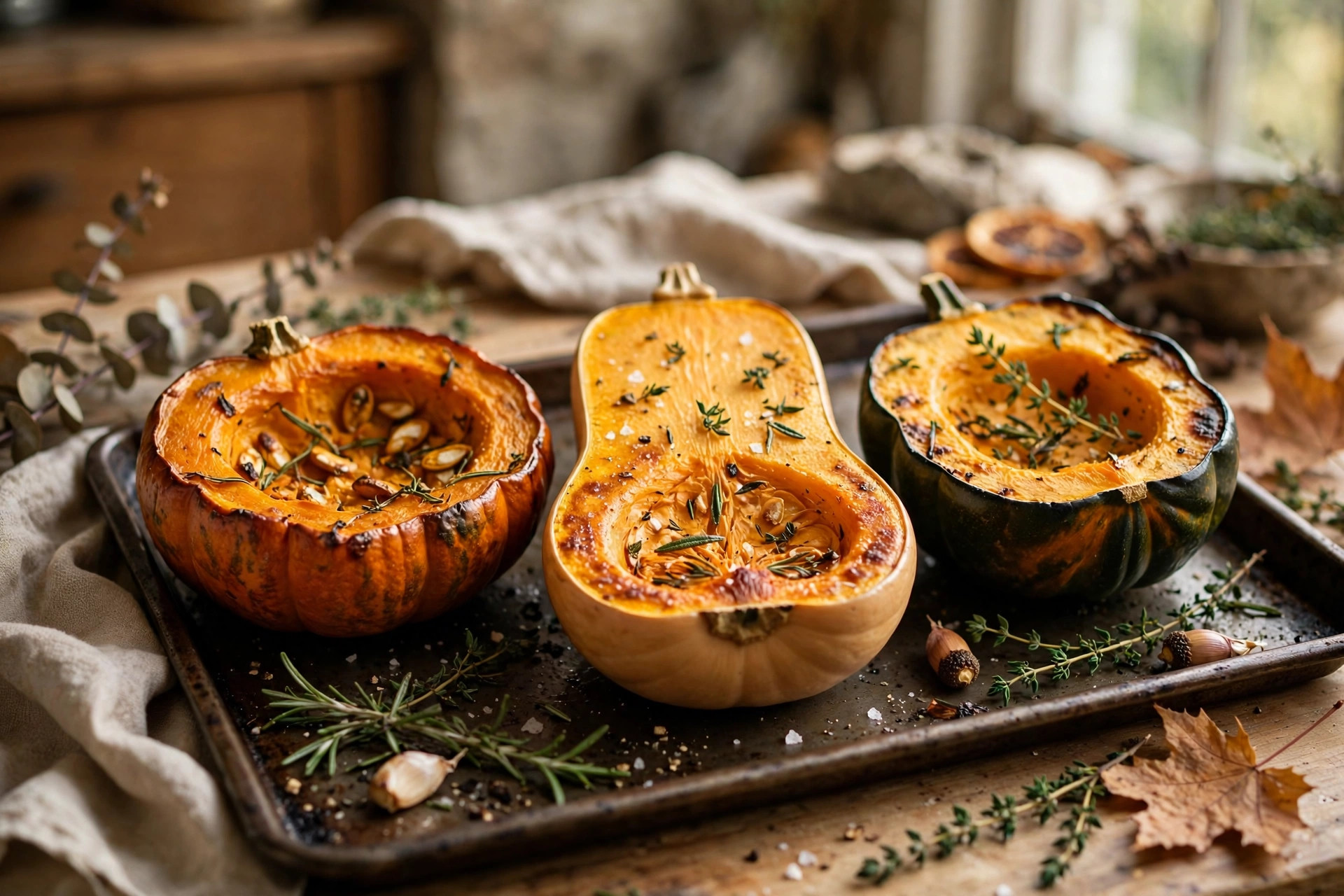
When the weather turns cooler and the markets fill with orange, green and cream-coloured squash, it is worth learning how to choose and cook them properly. Squash are generous vegetables: one large pumpkin can feed a family for several meals, a butternut roasts into sweet, caramelised cubes in under an hour, and an acorn squash halves make natural bowls for stuffing. This guide covers the three most useful types, how to tell a good one from a tired one, how to cut them safely, and five dependable ways to cook them.
Know your squash
Pumpkin is the largest and most familiar. Look for one that feels heavy for its size, with firm, unblemished skin and a dry, woody stem. A pumpkin with soft spots, cracks or a damp stem will not keep well. Smaller pumpkins, often sold as sugar pumpkins or pie pumpkins, have denser flesh and are better for cooking than the very large carving types, which tend to be watery. A pumpkin of about 2 kilograms will give you roughly 1.4 kilograms of peeled flesh, enough for a large pot of soup plus a tray of roast cubes.
Butternut squash is the easiest to work with. Its long neck is solid flesh with no seeds, so you get a lot of usable vegetable from one piece, and its smooth, pale skin peels easily with a vegetable peeler. Choose one that is evenly beige, with no green patches, which can mean it was picked too early, and no soft areas near the base. A butternut of about 1.2 kilograms serves four as a side dish, or two as a main course when it is stuffed.
Acorn squash is smaller, about the size of a large grapefruit, with deep ridges and a dark green or orange skin. Its shape means it is best halved and roasted, rather than peeled and cubed. Pick one that feels heavy, with no soft spots, and a small patch of orange on the skin, which shows it ripened on the vine. Because the skin is edible once roasted until tender, acorn squash is also the quickest of the three to prepare.
Storing squash
Whole, uncut squash keep well. Store them in a cool, dry place out of direct sunlight, such as a pantry shelf or a cool cupboard, where a pumpkin can last 6 to 8 weeks and a butternut or acorn squash 3 to 4 weeks. Do not store them in the fridge while whole, because the cold and damp can shorten their life. Once cut, wrap the pieces tightly and refrigerate them for up to 4 days. Peeled and cubed squash can also be frozen: spread the cubes on a tray, freeze until solid, then transfer them to a freezer bag, where they will keep for up to 3 months. Cook frozen cubes straight from the freezer, adding about 10 minutes to the roasting time.
Cutting squash safely
The hardest part of cooking squash is cutting it, and a few precautions make it much safer. Use a large, sharp knife, never a small or serrated one, and a stable chopping board with a damp cloth underneath to stop it slipping. For a pumpkin or butternut, first cut off the stem end and the base to create flat surfaces, then stand the squash on its base and cut it in half lengthways. Scoop out the seeds with a spoon, then peel the halves with a vegetable peeler before cutting them into cubes of about 2 centimetres. For an acorn squash, cut it in half through the stem, scoop out the seeds, and slice it into wedges if you want roast pieces, or leave the halves whole for stuffing. If a squash feels too hard to cut, microwave it whole for 2 to 3 minutes first; the skin will soften just enough to make the first cut easier.
Five ways to cook squash
Roasting is the most reliable method. Toss 1 kilogram of cubes with 2 tablespoons of olive oil, 1 teaspoon of salt, half a teaspoon of black pepper and a pinch of dried thyme, spread them on a lined tray in a single layer, and roast at 200 degrees Celsius, or 180 degrees for a fan oven, for 30 to 35 minutes, turning once, until the edges are golden and the centres are soft. Roast cubes are good on their own, in salads, or tossed through pasta.
For soup, you will need 1.2 kilograms of peeled, cubed pumpkin or butternut, 1 chopped onion, 2 chopped carrots, 2 garlic cloves, 1 litre of vegetable stock, 1 tablespoon of olive oil and a pinch of ground nutmeg. Soften the onion and carrots in the oil for 8 minutes, add the garlic and squash, pour in the stock, and simmer for 25 minutes until everything is soft. Blend until smooth, season to taste, and finish with a swirl of cream or a spoonful of yoghurt and a handful of toasted seeds.
Mash is a simple alternative to potatoes. Boil 1 kilogram of peeled cubes in salted water for 15 to 18 minutes until very soft, drain well, and mash with 40 grams of butter, a splash of warm milk, and a pinch of nutmeg. The mash should be smooth but still thick; if it is watery, return it to the pan over a low heat for 2 minutes, stirring, to dry it out. It pairs well with roast chicken, sausages, or a simple bean stew.
Stuffed acorn squash makes a complete meal. Halve 2 acorn squash, scoop out the seeds, brush the cut sides with olive oil and salt, and roast cut side down at 200 degrees Celsius for 30 minutes. Turn them over and fill each half with a mixture of 200 grams of cooked rice, 150 grams of cooked chickpeas, 1 chopped red onion, 2 chopped tomatoes, a handful of chopped parsley and 50 grams of crumbled feta. Return them to the oven for 15 minutes until the filling is hot and the cheese is golden.
Finally, squash works well in baking. For muffins, you will need 250 grams of plain flour, 2 teaspoons of baking powder, 1 teaspoon of ground cinnamon, 150 grams of caster sugar, 2 eggs, 120 millilitres of vegetable oil, and 300 grams of grated raw butternut or pumpkin, squeezed dry in a clean cloth. Mix the dry and wet ingredients separately, combine them gently, spoon into a lined 12-hole muffin tin, and bake at 180 degrees Celsius for 20 to 22 minutes, until a skewer comes out clean. They keep for 3 days in an airtight tin, or freeze well for a month.
Seasoning and flavour pairings
Squash has a naturally sweet, earthy flavour, so it suits both sweet and savoury seasonings. Sage, thyme and rosemary are the classic herbs, and a few fresh sage leaves fried in butter make a simple sauce for roast squash. Cumin, coriander, smoked paprika and chilli flakes give it a warmer, spicier character, while cinnamon, nutmeg and ginger suit soups and baking. It also pairs well with garlic, onions, apples, walnuts, hazelnuts, feta, parmesan, cream cheese and toasted seeds. When you are trying a new combination, season in stages and taste as you go, because squash varies in sweetness from one piece to the next.
Troubleshooting
If roast squash is soft but not browned, the oven may not be hot enough, or the cubes may be crowded; spread them out and raise the temperature by 10 degrees. If soup is too thick, add stock a ladle at a time until it reaches the consistency you like. If mash is watery, drain it thoroughly and dry it in the pan as described above. If a stuffed squash is still firm after the stated time, cover it with foil and give it another 10 minutes; larger squash simply take longer. And if you buy a squash that turns out to be bland, roast it longer, season it generously, and serve it with a sharp cheese or a squeeze of lemon to lift the flavour.
Squash rewards a little patience: choose a heavy, firm one, cut it carefully, and cook it until it is properly golden rather than just soft. Once you have roasted a tray, made a pot of soup and tried a stuffed half, you will find it becomes a regular part of your autumn cooking, and one large pumpkin will rarely go to waste.
Please note: this article is general food information only and is not medical advice. Adjust quantities and ingredients to suit your own tastes, dietary needs and household, and take care when using sharp knives and hot ovens.